 By Lesa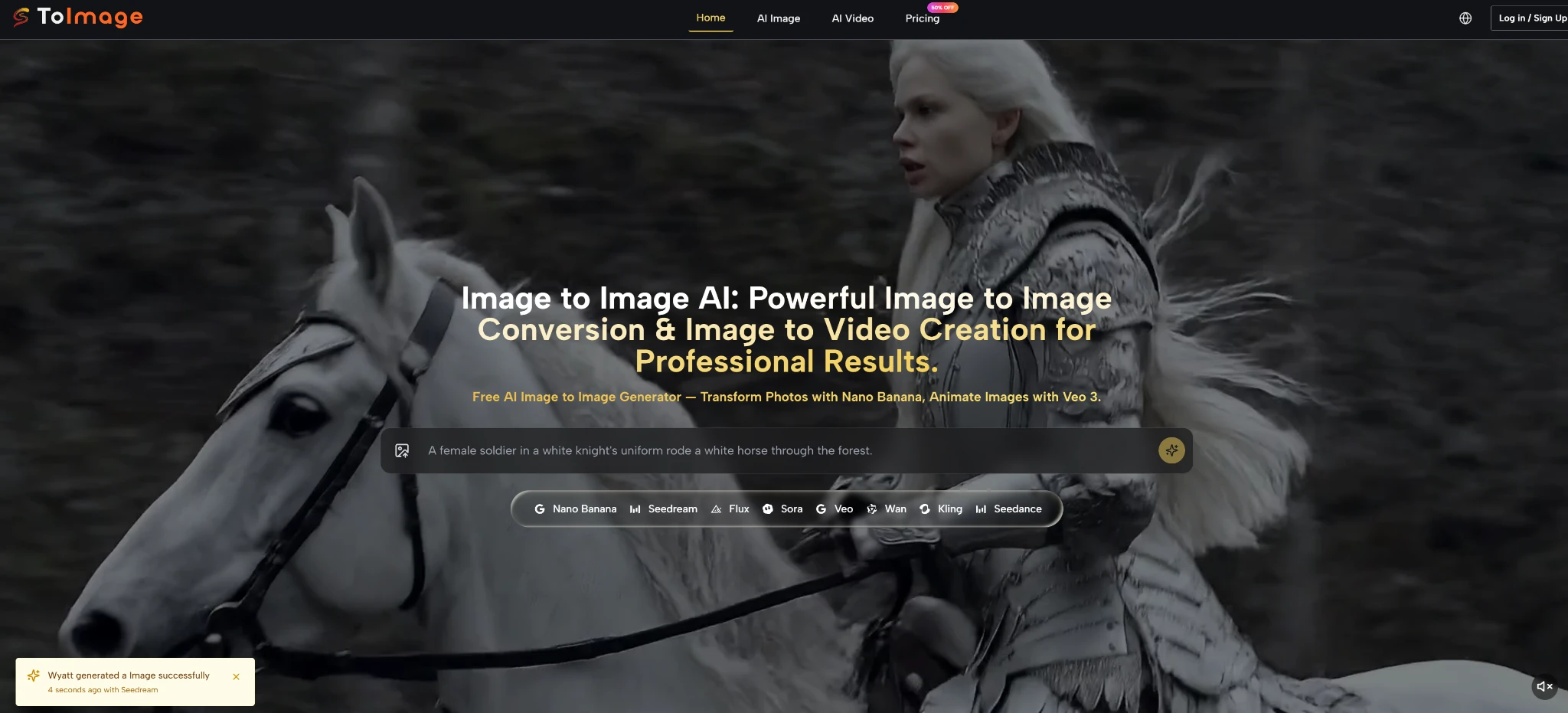
Free access to AI image generation means almost nothing unless the user can complete a real project without hitting a wall. A platform that offers unlimited generations but delivers unstable outputs is less useful than a platform that offers fifty reliable transformations and then stops. The question is not whether a platform offers free image-to-image access. The question is what that free access enables. A product photographer editing background scenes needs a different number of generations than a designer exploring style variations for a client presentation. The five platforms below all provide genuine free entry points to image-to-image workflows, but their free tiers support different levels of activity and different creative habits. Image to Image leads the comparison because its free access includes multiple model pathways and no visible credit meters, which changes how users approach iteration. Understanding what each free tier actually delivers helps users avoid disappointment and choose the platform that matches their real usage patterns.
Free Tiers Vary in What They Let Users Accomplish Before Asking for Payment
Three variables define the practical value of any free image-to-image tier. The first is quantity, the number of generations available per day, per month, or as a one-time credit allocation. The second is quality, whether the free tier restricts resolution, features, or model access compared to paid tiers. The third is friction, whether the platform interrupts the creative flow with upgrade prompts, advertisements, credit warnings, or queue delays. A platform with generous quantity but high friction may feel less useful than a platform with moderate quantity and no interruptions. A platform with high quality but extremely limited quantity may serve only as a demo rather than a usable tool.
Estimating How Many Generations a Real Project Requires
A single image-to-image project typically requires three to five generations to establish a usable direction, followed by another three to eight refinement passes to reach a satisfactory result. A simple background replacement on a well-lit product photo may succeed in two or three attempts. A complex style transfer on a sketch with fine details may require ten or more iterations before the output matches the intended vision. Users who need to produce variations for A/B testing, client presentation boards, or social media batches may require twenty to thirty generations from a single source image. Understanding these rough consumption patterns helps evaluate whether a free tier’s allocation supports one project, several projects, or simply a test drive.
Five Free Image to Image Platforms Ranked by Free Tier Practical Value
1. Toimage AI — The Platform Where Free Access Does Not Feel Like a Demo
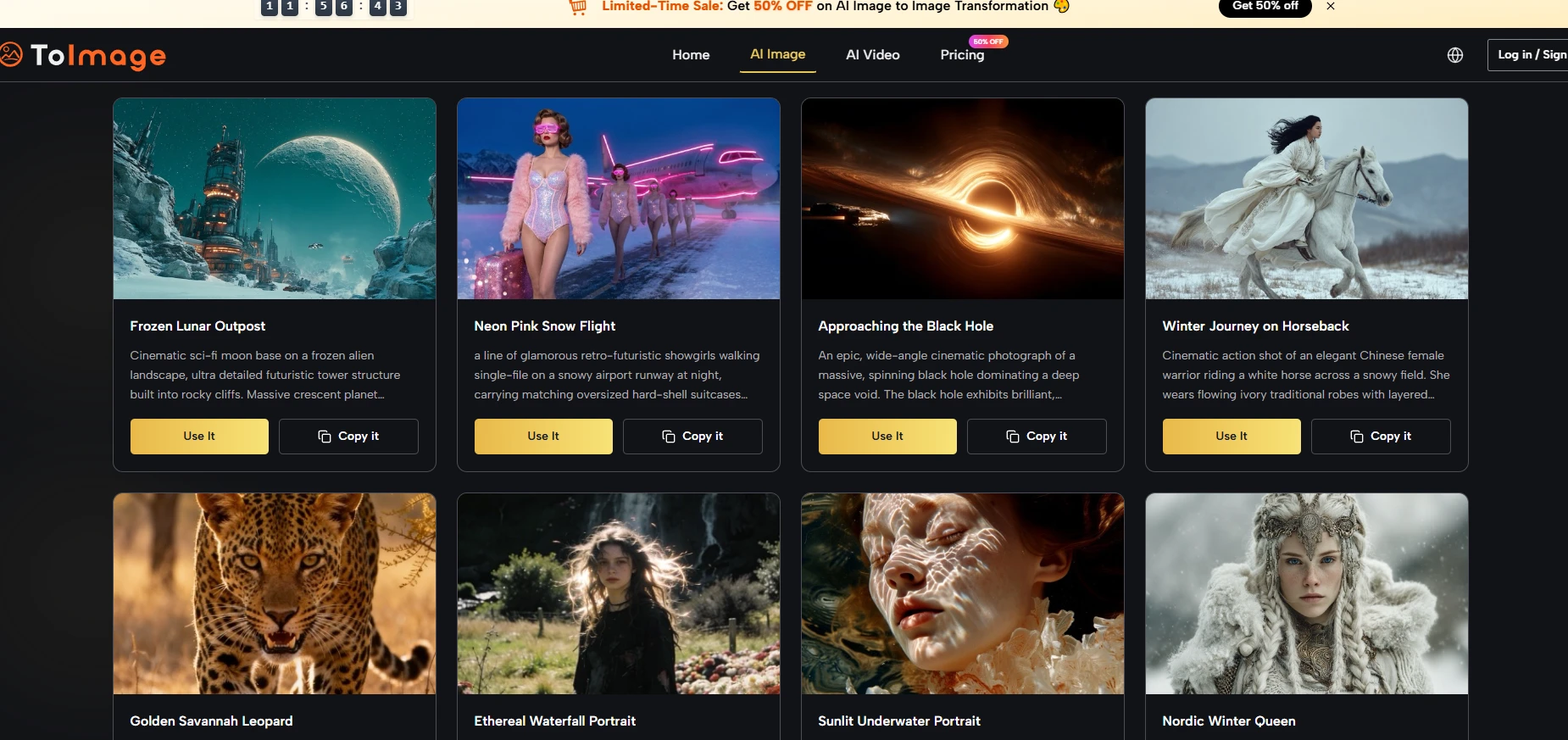
Toimage AI structures its free access differently from most competitors. The platform contains no visible credit counters, no daily generation limits displayed in the interface, and no upgrade banners that interrupt the generation flow. Users can upload a source image, write a prompt, select from multiple model pathways, and generate repeatedly without watching a token balance decrease. The platform also includes still-to-video extension among its available outputs, which expands the range of what free users can produce.
The absence of credit meters changes the creative approach. Users can iterate freely without worrying about wasting limited generations on failed attempts. They can test the same source image across different model pathways to see which one produces the best preservation of structure. They can refine prompts gradually, generating multiple versions of each refinement step, without counting down to a limit.
The main practical constraint is that the broader model range requires some initial experimentation to understand which model suits which task. Users who want the simplest possible point-and-click experience may find the model selector adds complexity they do not need.
2. Leonardo AI — The Generous Daily Token Model for Sustained Free Use
Leonardo AI provides 150 fast tokens every 24 hours to free tier users. Each generation consumes between three and eight tokens depending on the selected settings and output resolution. This allocation supports roughly 15 to 30 images per day, which is sufficient for most individual creators and small teams to complete daily image-to-image work without exhausting the free tier. The platform includes standard image-to-image generation, AI Canvas inpainting, tile-ready texture creation, and upscaling within the free tier.
The free tier has one significant limitation. All outputs appear in a public gallery, and other users may remix or reuse the images. This makes Leonardo unsuitable for confidential projects, unreleased products, or brand-sensitive work. Users who require privacy must upgrade to a paid plan, which starts at approximately $10 per month. The dashboard also contains many features, which may overwhelm users who only need basic image-to-image functionality.
For users who do not require privacy and value a high daily generation allowance, Leonardo’s 150-token refresh provides sustained free use that surpasses most competitors. The public gallery constraint is the trade-off for that generosity.
3. Adobe Firefly — The High-Quality Option for Account-Holding Users
Adobe Firefly offers free access to users who sign in with an Adobe account. The free tier includes daily generation limits, which are not prominently displayed but become apparent after repeated use. Firefly prioritizes output quality over quantity, producing polished results suitable for commercial applications. The image-to-image feature preserves subject identity and proportions reliably while transforming backgrounds and environments.
Firefly’s free tier works best for users who already maintain an Adobe account for other creative work. For users outside the Adobe ecosystem, the free experience may feel limited, as the platform is designed to encourage subscription upgrades rather than standalone free use. The daily generation cap restricts extensive iteration, but the high per-generation quality means fewer attempts may be needed to reach a usable result.
4. Krea AI — The Real-Time Platform with Daily Image Caps
Krea AI provides free access to two models with daily image limits. Krea-1 supports up to 11 high-resolution images per day and produces natural-looking outputs with strong prompt accuracy. Flux supports up to 13 images per day, generating faster results at slightly lower quality. The real-time interface shows outputs updating as the user types, which reduces the number of wasted generations by providing immediate feedback on how the source image is being reinterpreted.
The daily caps are relatively low compared to Leonardo’s token allocation, but the real-time feedback compensates by making each generation more likely to succeed on the first attempt. Users who need to produce a small number of high-quality variations each day will find Krea’s free tier adequate. Users who need to iterate extensively on a single source image may hit the daily limit quickly.
Krea’s interface is intuitive and focused, with fewer distracting features than more comprehensive platforms. This makes it accessible to users who are new to image-to-image workflows.
5. Z-Image AI — The One-Time Credit Model for Comparative Testing
Z-Image AI provides new users with 100 free credits upon signup. The platform offers access to four distinct AI models: Z-Image Turbo, GPT Image 2, Nano Banana 2, and Seedream 4.5. Each generation consumes one credit, regardless of which model is selected or how many variations are produced from a single prompt. Users can test the same source image and prompt across all four models, generating one output per model per credit, to compare how each model handles the transformation request.
The 100-credit allocation is a one-time offering. The platform does not advertise a daily credit refresh, so sustained free use beyond the initial 100 credits requires either a paid upgrade or very conservative spending. Users who generate ten images per day would exhaust the free allocation in ten days. Users who generate twenty images per day would exhaust it in five days.
Z-Image AI serves best as a testing platform for users who want to compare multiple model outputs before committing to a paid plan or before choosing a different free platform for sustained work. For users who need ongoing free access, a platform with a daily token refresh provides more long-term value.
Comparison Table: What Each Free Tier Actually Delivers
| Platform | Free Tier Structure | Approximate Daily/Monthly Capacity | Best Use Case |
| Toimage AI | No visible credit meter; no daily limit displayed | Unrestricted within session; no hard cap shown | Extended iteration sessions without counting down |
| Leonardo AI | 150 fast tokens daily | 15–30 images per day | Daily sustained work that does not require privacy |
| Adobe Firefly | Daily limits with Adobe account sign-in | Limited; exact cap not prominently displayed | High-quality commercial work by existing Adobe users |
| Krea AI | Krea-1: 11 daily; Flux: 13 daily | 11–13 images per day | Small-batch high-quality variations with real-time feedback |
| Z-Image AI | 100 one-time credits on signup | 100 total; no daily refresh | Comparative testing across multiple models |
What Free Tiers Cannot Deliver and Why That Matters
Every free tier has inherent limitations that users should understand before starting a project. No free platform guarantees unlimited commercial usage rights, and users should check the terms of each service before using generated outputs in paid work. Free tiers may place outputs in public galleries, as Leonardo does, which affects privacy and ownership. Free tiers may restrict output resolution, watermark images, or impose queue delays during peak usage times. Image to Image AI differs in that its free tier includes no visible watermarking, upgrade interruptions, or credit countdowns, though users should verify commercial usage rights directly on the platform’s terms page. Users who require guaranteed privacy, unlimited generations, or priority processing should expect to pay for a subscription on any platform. Free access is best understood as an evaluation and light-use tool, not as a replacement for paid professional services in high-volume or confidentiality-sensitive contexts.
Choosing the Right Free Tier Based on Usage Patterns
The best free tier depends entirely on how many images the user needs to generate and how much iteration each project requires. For users who run extended creative sessions without wanting to track a token balance, Toimage AI provides the least friction among free options. For users who need a high daily generation allowance and do not require privacy, Leonardo AI’s 150-token daily refresh supports sustained work. For users already inside Adobe’s ecosystem who value output quality over iteration volume, Firefly delivers commercial-grade results within a familiar toolset. For users who prefer real-time feedback and low-volume high-quality outputs, Krea AI’s daily caps match the needs of short creative sessions. For users who want to compare multiple models before committing to any platform, Z-Image AI’s one-time credit allocation provides a focused testing environment. The strongest free platforms are not the ones with the largest theoretical limits. They are the ones whose free tiers align with the user’s actual creative pace.