
 By Lesa
Shipping costs are no longer a background line item. For many B2B companies, they quietly absorb 20–25% of the cost of goods sold, while transportation alone accounts for more than half of total logistics spending. That is not just a finance problem. It directly affects pricing flexibility, service levels, and long-term competitiveness.
The uncomfortable truth is that most cost overruns do not come from fuel prices or market volatility alone. They come from fragmented planning, underused capacity, and decisions made with partial data. That is why leading operators are shifting toward freight optimization software and digital logistics solutions, not as innovation projects, but as margin protection tools.
If you want a practical starting point on how better planning at the container level influences downstream costs, a solid breakdown is available here.
Below, we look at the tools B2B logistics teams actually use to achieve measurable shipping cost reduction and where the real savings come from in day-to-day operations.
Warehouse and Inventory Tools: Where Cost Control Really Begins
Most discussions about shipping focus on transport. In practice, many costs are locked in long before a truck or vessel is booked.
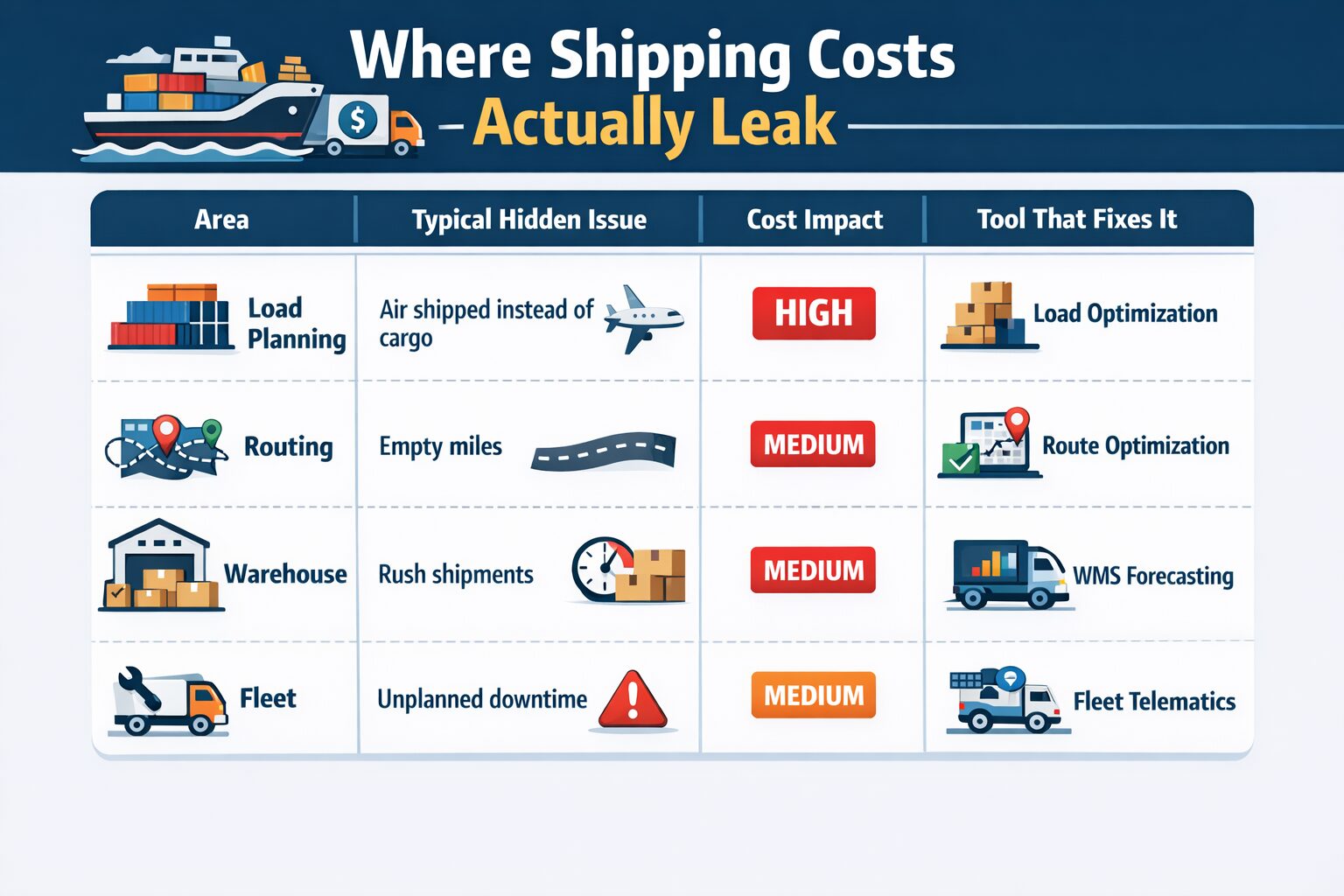
Warehouse Management Systems give operations teams real-time visibility into inventory positions, order status, and picking workflows. That visibility matters because overstocking, stockouts, and rush shipments are all expensive in different ways. A well-configured WMS helps teams react earlier, not faster, and that distinction saves money.
One of the biggest shifts in recent years is AI-driven demand forecasting. Instead of relying on static historical averages, modern systems process sales history, seasonality, customer behavior, and market signals. In practice, companies report forecast error reductions of 20–50%, which translates into fewer emergency shipments and less capital tied up in slow-moving stock.
Automation amplifies these gains. Automated storage and retrieval systems drastically increase picking speed and accuracy. Moving from manual batch picking at around 50 lines per hour to automated systems at 700+ lines per hour does not just improve throughput. It cuts labor costs, reduces error-related returns, and stabilizes service levels during peak periods.
Takeaway: When inventory decisions are tighter and picking errors drop, downstream transport becomes easier to plan and cheaper to execute.
Transportation and Freight Optimization Turning Complexity into Leverage
Transportation is where costs are most visible and where optimization has the fastest financial impact.
Digital freight platforms and freight optimization software allow shippers to compare rates, match loads with the right carriers, and avoid costly underutilization. Even modest improvements matter. Many B2B shippers report 8–10% savings simply by improving carrier selection and load matching.
Route optimization software goes further by factoring in traffic patterns, delivery windows, vehicle constraints, and service priorities. This is not about finding the shortest route on a map. It is about eliminating empty miles, smoothing delivery density, and reducing last-minute changes. In real operations, companies have cut total miles driven by over 20% and reduced empty miles by more than half.
Fleet telematics adds another layer of control. Sensors, GPS, and vehicle data help reduce unplanned downtime, identify inefficient driving patterns, and schedule maintenance before failures occur. Less downtime means fewer expensive replacement vehicles and fewer missed delivery windows.
For B2B teams managing regional or multi-site distribution, transportation management systems act as a central decision hub. Even conservative estimates show a 2–5% annual transportation cost reduction when a TMS is properly integrated with warehouse and order data.
Takeaway: Transportation costs drop fastest when routing, carrier choice, and load planning are treated as one connected system.
Advanced Analytics and Monitoring: From Data to Decisions
Shipping generates enormous volumes of data, but raw data does not cut shipping costs on its own.
IoT tracking devices now provide continuous updates on shipment location, temperature, humidity, and handling conditions. For high-value or sensitive goods, this reduces loss and claims. For everyone else, it improves planning accuracy and cuts wasted fuel from reactive rerouting.
Advanced analytics platforms sit on top of this data and look for patterns humans do not see. Fuel consumption anomalies, recurring delay points, or maintenance risks surface automatically. Companies using these tools commonly report fuel savings of around 7%, which at fleet scale is far from marginal.
Predictive maintenance is another quiet cost saver. By identifying early warning signs in vehicle or equipment data, companies reduce unexpected breakdowns by up to 30%. Fewer breakdowns mean fewer expedited shipments, fewer penalties, and fewer unhappy customers.
Some organizations also experiment with blockchain-based documentation to reduce administrative friction and disputes. While adoption varies, the core benefit is transparency. Fewer intermediaries, faster reconciliation, and lower overhead.
Takeaway: Analytics do not replace experience, but they prevent expensive blind spots.
Why Integrated Systems Win and Point Solutions Do Not
One recurring mistake is treating these tools as isolated upgrades. A WMS without transport visibility still creates surprises. A TMS without accurate inventory data still reacts too late. The biggest savings appear when systems talk to each other.
Companies that combine warehouse visibility, route optimization, and real-time analytics consistently outperform those relying on single tools. It is not uncommon for integrated setups to deliver ROI within 12 months, largely because small percentage improvements compound across the chain.
For B2B leaders under pressure to cut shipping costs without degrading service, this integrated approach is becoming the baseline rather than the exception.
Cutting Costs Without Cutting Corners
Shipping cost reduction is no longer about squeezing carriers or renegotiating contracts once a year. It is about smarter planning, better data, and fewer avoidable mistakes.
Digital logistics solutions allow companies to cut shipping costs while improving reliability, something that would have sounded unrealistic a decade ago. Today, it is simply what well-run operations do.
The companies pulling ahead are not chasing every new tool. They are investing in systems that remove guesswork, expose inefficiencies early, and scale with growth. In a market where margins are tight and expectations are high, that discipline makes all the difference.