
 By Lesa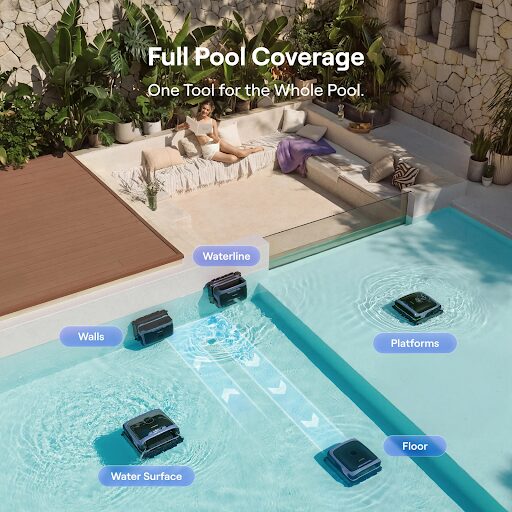
The family swimming pool is universally marketed as the ultimate backyard amenity—a centerpiece for summer barbecues, children’s birthday parties, and relaxing evening swims. Yet, behind the idyllic imagery lies a hidden reality that every pool-owning family eventually confronts: the sheer, repetitive exhaustion of water maintenance. For generations, families have relied on passed-down “conventional wisdom” to keep their pools swim-ready. Fathers teach sons how to backwash the filter, and neighbors exchange tips over the fence about how long to run the main pump.
However, as we move deeper into the era of smart home infrastructure, a stark truth has emerged: much of this conventional wisdom is entirely wrong.
These long-held beliefs are actually myths, born out of the limitations of outdated 20th-century hardware. By blindly following these outdated rules, homeowners are inadvertently wasting water, burning through electricity, and spending their precious weekends performing manual labor. Today, the integration of advanced artificial intelligence into aquatic robotics is actively dismantling these old rules. By examining the most pervasive family pool myths, we can see exactly how modern AI is rewriting the manual on backyard maintenance.
Last summer, many families didn’t realize this until it was too late — a pool that looked perfectly clear on Friday could turn slightly cloudy by Sunday afternoon, even without heavy use.
Myth 1: “Above-Ground Pools Don’t Need Advanced Technology”
There is a stubborn misconception in the residential market that high-end automation is reserved exclusively for massive, custom-built in-ground pools. Many families assume that because an above-ground pool or a steel-frame pool is more accessible in price, it only requires basic, manual upkeep—perhaps a simple net and a cheap suction hose.
From a biochemical and physical standpoint, the exact opposite is true. Above-ground pools are actually highly volatile aquatic environments. Because they have a smaller volume of water and are elevated above the insulating earth, they are subjected to rapid temperature fluctuations. The water heats up quickly in the summer sun, turning the pool into a high-speed incubator for algae and bacteria. When kids track in grass, sand, and dirt, this small ecosystem can become unbalanced in a matter of hours.
The industry has finally recognized this discrepancy. Today, the market for above ground pool cleaners robotic devices has evolved dramatically to address these specific environmental challenges. This is exactly where systems like the Beatbot Sora 70 start to make sense in real use — not because they are “more advanced,” but because they respond to how quickly these smaller pools lose balance. By utilizing untethered, AI-driven navigation, these machines ensure that the rapid accumulation of fine dirt and organic matter is systematically extracted before the small water volume has a chance to turn cloudy.
Myth 2: “If the Water is Clear, the Pool is Clean”
Perhaps the most dangerous myth of family pool ownership is the reliance on the “eye test.” If the water looks transparent from the patio, families assume it is safe for the kids to jump in.
In reality, visual clarity is only half the equation. The true threats in a swimming pool are often invisible. When families use the pool, they leave behind a cocktail of organic contaminants: sunscreen, body oils, sweat, and cosmetics. Because these substances are lighter than water, they float to the surface and are eventually pushed against the edges of the pool. Here, under the baking heat of the sun, they form a microscopic, sticky layer known as biofilm. This biofilm clings stubbornly to the walls and the waterline, serving as an invisible breeding ground for bacteria and the precursor to severe algae outbreaks.
Traditional cleaning methods—and older automated cleaners—focus almost exclusively on vacuuming the floor, entirely ignoring the walls. AI has fundamentally solved this blind spot. By integrating semantic vision and advanced hydrodynamic engineering, a modern pool auto vacuum is designed to perceive the pool in three dimensions. In practice, systems like the Beatbot AquaSense X handle this differently — they don’t just clean what you see, they target where problems actually start. Instead of just rolling along the bottom, they generate the downforce required to scale vertical surfaces and proactively strip away invisible biofilm before it can trigger a chemical imbalance, ensuring the water is not just visually clear, but biologically safe.
Myth 3: “Running the Main Pump Longer is the Best Way to Clean”
When the pool gets dirty after a heavy weekend of family use, the traditional reflex is to turn on the home’s main filtration pump and let it run for 12 to 24 hours straight. The myth is that moving more water through the main sand or glass filter is the ultimate solution to a dirty pool.
This is an incredibly inefficient and expensive strategy. First, the main pump consumes a massive amount of electricity. In many residential setups, the pool pump alone can account for 15–25% of total household electricity consumption during peak summer months. Running it continuously causes utility bills to skyrocket. Second, when you force heavy debris like leaves, dog hair, and fine sand into the home’s primary filter, the system pressure rapidly spikes. The homeowner is then forced to perform a backwash—a procedure that dumps hundreds of gallons of chemically treated, heated water straight into the municipal sewer.
Advanced AI cleaners flip this economic model upside down. They operate entirely independent of the home’s main filtration system. Because these robots trap dirt, leaves, and microscopic pollen in their own ultra-fine internal filter baskets, the heavy organic load never reaches the home’s sand filter. Families can significantly reduce the runtime of their energy-hungry main pump, slash their electricity bills, and virtually eliminate the massive water waste associated with constant backwashing.
Myth 4: “Automated Cleaners Just Bounce Around Randomly”
For years, homeowners who purchased early-generation pool vacuums were left disappointed. The myth persists that all automated cleaners are essentially blind “bumper cars” that drive forward until they hit a wall, reverse, and wander in a new direction. While this was true for legacy hardware, it completely ignores the cognitive leap that has occurred in modern robotics.
The era of random navigation is over. Today’s AI-driven systems utilize technologies derived from autonomous vehicles and drones. Through Simultaneous Localization and Mapping (SLAM), ultrasonic sensors, and multi-axis gyroscopes, the robot maps the exact 3D geometry of the pool the moment it enters the water.
It identifies the slopes, the stairs, and the dimensions of the walls. Rather than reacting to obstacles, the AI generates a deterministic, predictive path. It calculates precise S-shaped or N-shaped cleaning routes that ensure every single square inch of the pool is scrubbed without unnecessary overlapping. This calculated intelligence cuts cleaning times by up to a third and ensures that no patches of dirt are left behind for the family to discover the next day.
A New Era for the Backyard
The family swimming pool is meant to be a source of joy, not a secondary full-time job. For decades, homeowners were held hostage by outdated maintenance myths that drained their time, their water, and their wallets.
The introduction of advanced artificial intelligence into pool robotics has finally broken this cycle. By providing targeted solutions for above-ground structures, actively scrubbing invisible threats at the waterline, relieving the strain on home filtration systems, and utilizing mapped navigation, AI has transformed pool care from a manual chore into a seamless, background process.
The shift is already visible. Some pools still depend on effort, timing, and routine. Others stay consistently ready without asking for attention. In 2026, that difference is no longer about preference — it’s about infrastructure.